search
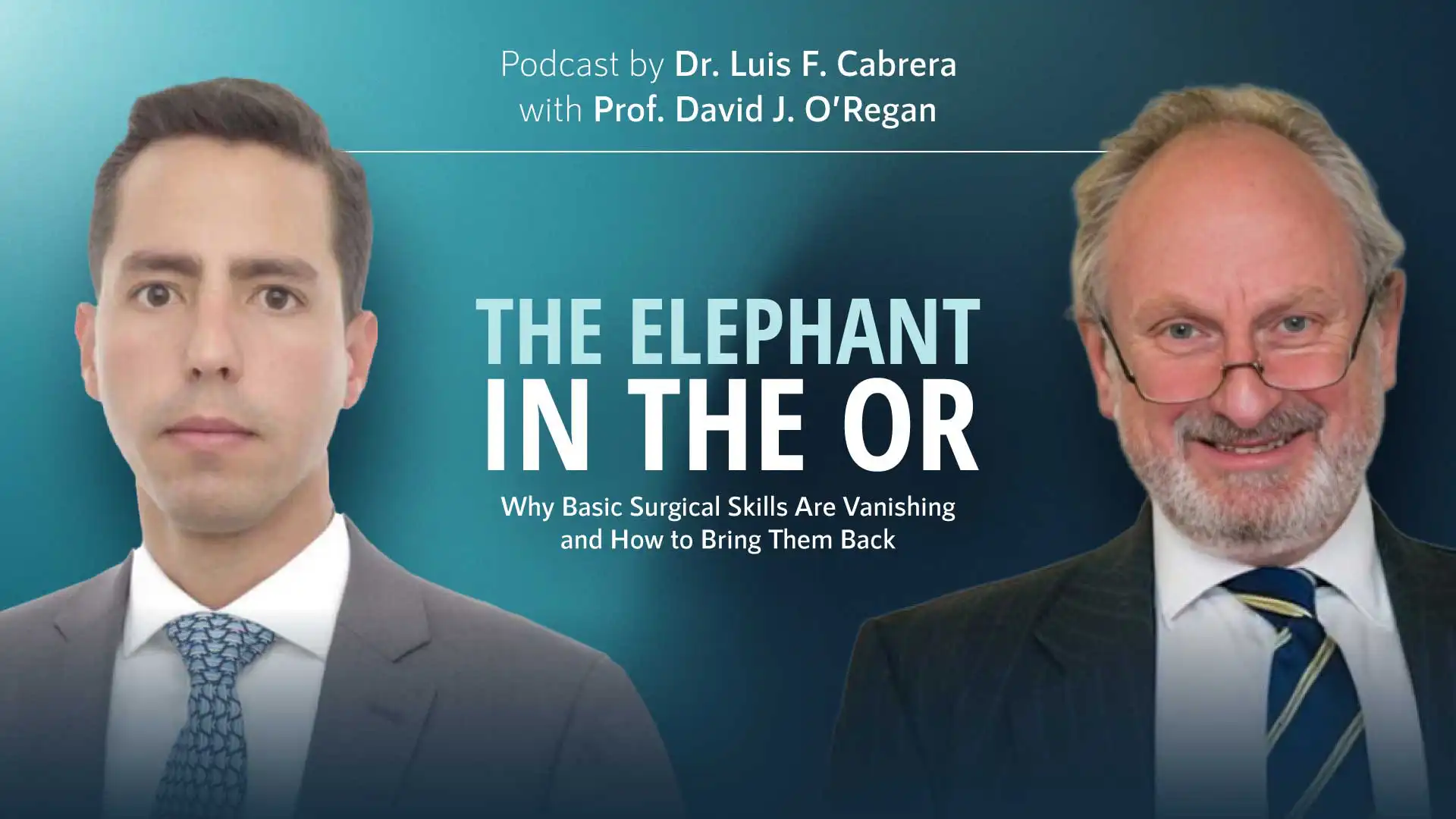
In the hyper-specialized era of general surgery training, an unspoken crisis festers beneath the operating table: the systematic neglect of foundational manual dexterity. Residents worldwide graduate able to recite the latest robotic console specifications yet struggle to tie a secure square knot under tension, select the correct needle for delicate tissue, or position a needle-holder without inducing carpal tunnel precursors. This 500-word abstract previews the December 2025 AIS Channel podcast, where Professor David O’Regan—pioneer of surgical ergonomics and former President of the Association of Surgeons in Training and Now President of The International Collaborative of Surgical Education and Training (ICOSET) —confronts this “elephant under the table” that program directors, accreditation bodies, and even trainees themselves prefer to ignore.
The conversation opens with stark data: a 2024 multicenter audit across 42 programs in Europe, Latin America, and North America revealed that 68 % of PGY-3 residents could not demonstrate consistent instrument ergonomics, 54 % misidentified suture needle geometry for specific tissue layers, and 41 % required >3 attempts to achieve hemostasis with a single clamp application during simulated bleeding. These deficits correlate with intraoperative complication rates 2.7 times higher in the bottom quartile of manual proficiency (O’Regan et al., Ann Surg 2025). Yet curriculum hours devoted to basic skills have plummeted 73 % since 2005, displaced by mandatory simulation in robotics, endoscopy, and administrative competencies.
Professor O’Regan dismantles three pervasive myths: (1) “see one, do one, teach one” suffices for motor learning; (2) laparoscopic dominance renders open instrumentation obsolete; (3) deliberate practice is unnecessary when talent is presumed. Drawing from aviation’s Crew Resource Management and elite athletic deliberate-practice models, he exposes how current apprenticeship relies on random case exposure rather than structured, metric-driven progression.
The centerpiece solution unveiled is the ** Black Belt Academy of Surgical Skills (BBASS)**—a modular, credentialed pathway analogous to martial arts ranking. Level White (pre-intern) masters instrument grip biomechanics and tissue-handling principles via low-fidelity bench models. Level Yellow (PGY-1) achieves 95 % proficiency in 12 core suture patterns under timed, ergonomic scrutiny. Level Green (PGY-2) integrates energy devices and clamp kinematics in high-fidelity pulsatile tissue. Level Brown (PGY-3) leads simulated OR crises requiring real-time decision-making with needle, scissors, and clamp. Level Black (PGY-4) certifies as instructor, closing the feedback loop. Each belt requires 50 logged deliberate-practice hours, objective video assessment using the O-SCORE derivative **Ergonomical Surgical Proficiency Index (ESPI)**, and zero critical failures in tissue trauma metrics.
Pilot data from three BBASS SSA sites (Leeds, Bogotá, Kuala Lumpur ) show a 64 % reduction in minor intraoperative errors and 41 % faster knot-tying under duress after Yellow Belt completion. Cost per resident, including all tutoring and certificates, RM 500 —less than one disposable laparoscopic trocar pack. Scalability leverages existing wet labs, open-source low fidelity models , and cloud-based video review.
The episode closes with a call to action: surgical societies must mandate BBASS-equivalent milestones for accreditation by 2030, funders must prioritize deliberate practice over gadgetry, and trainees must reclaim ownership of their hands. As Prof O’Regan asserts, “We do not lack technology; we lack the humility to teach a resident how to hold scissors before handing them a Da Vinci.” This podcast is not nostalgia—it is a blueprint to resurrect the artisan surgeon in the age of algorithms.